


Welcome to the AI Safety Newsletter by the Center for AI Safety. We discuss developments in AI and AI safety. No technical background required.
In this edition, we look at the re-release of Anthropic’s latest model, Fable 5, the US government’s decision to restrict access to OpenAI’s GPT-5.6, and two benchmarks that suggest AI capabilities have been improving exponentially in recent months.
Listen to the AI Safety Newsletter for free on Spotify or Apple Podcasts.
Fable 5 Access Restored Globally
On June 30, Anthropic announced that the US government had lifted its restrictions on Fable 5, and the model was redeployed to users globally on July 1. The White House implemented these restrictions due to a cybersecurity jailbreak that is now addressed.
The US government restricted Fable 5 shortly after its release in early June. On June 9, Anthropic released Fable 5 to the public, alongside their continued private deployment of Claude Mythos, the version of the model without safeguards, for trusted organizations. On June 12, the US government issued a directive banning both models for non-US citizens due to national security concerns with its cybersecurity abilities. Anthropic then suspended access for all users, since it could not filter citizen and non-citizen users. The government’s decision was reportedly prompted by Amazon’s discovery of a jailbreak that allowed Fable to search for cyber vulnerabilities. The model’s safeguards were supposed to block that type of use.
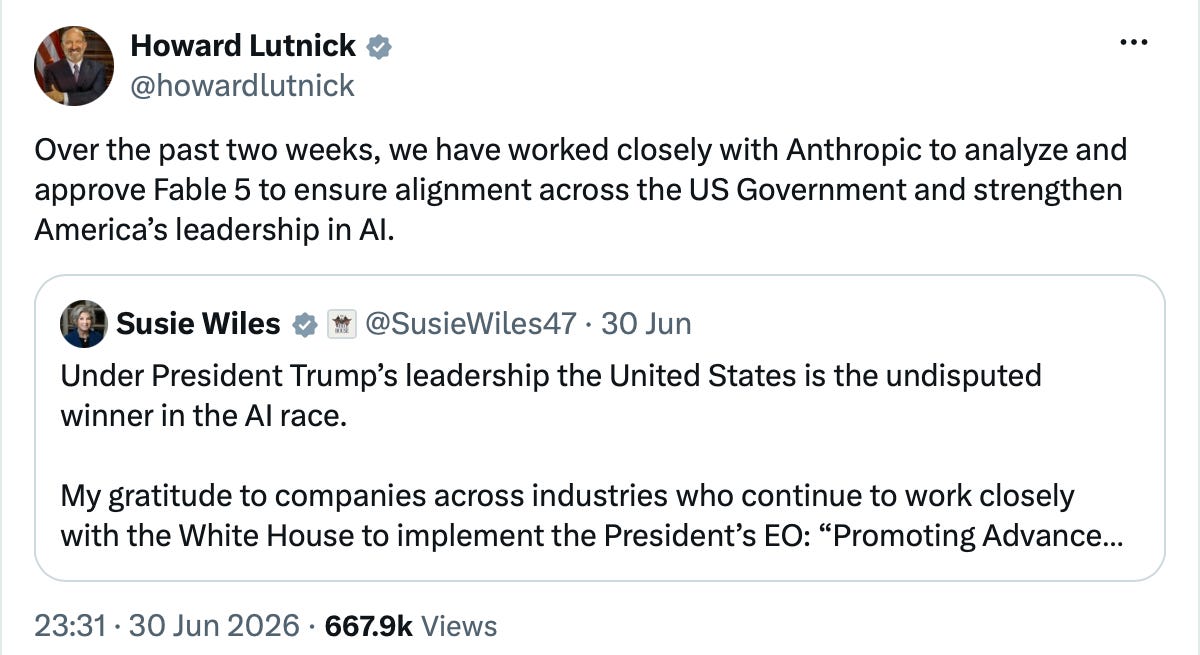
The US government and Anthropic have been cooperating to address concerns. Announcing the redeployment of Fable 5 on June 30, Anthropic said it had worked closely with the US government to develop a system that detects and blocks jailbreak attempts with high accuracy. US Commerce Secretary Howard Lutnick also said in an X post (above) that the government had worked with Anthropic to “analyze and approve Fable 5 to ensure alignment across the US Government and strengthen America’s leadership in AI.”
Anthropic called for a more standardized approach to approving model releases. In Anthropic’s June 12 statement announcing the restrictions, the company described the jailbreak the government raised concerns about as “narrow” and said it did not provide any greater assistance with malicious activities than other publicly available models. In its June 30 redeployment announcement, Anthropic called for a “shared industry framework” for evaluating jailbreak severity and for standards to be applied consistently going forward. The Financial Times reported that the White House is accelerating its work on a more systematic approach to approving models, which it may publish as early as this week. The same article suggested that the Center for AI Standards and Innovation and the National Security Agency would “play a crucial role in setting and monitoring the standards.”
Government involvement will be the norm for future releases by frontier developers. A letter from Lutnick to Anthropic reportedly states that the company “has agreed to proactively detect and address security risks associated with the models” as well as to collaborate on future releases and notify the government of malicious activity. The government may become increasingly involved in other frontier developers’ releases too; late in June, OpenAI announced that it had been asked by the government to stagger the release of its newest model to allow for safety evaluations before it is made publicly available.
OpenAI Limits Initial GPT-5.6 Release at Government Request
On June 26, OpenAI announced it was previewing its latest model series, GPT-5.6, with a “small group of trusted partners,” delaying a wider release at the request of the US government. The White House’s request for a staggered release is reportedly due to cybersecurity concerns similar to those that prompted the export controls on Anthropic.

GPT-5.6 Sol exhibits strong dual-use capabilities. OpenAI has introduced three models within its GPT-5.6 series: Sol, Terra, and Luna, in descending order of capability. The company says Sol is its flagship model with stronger capabilities than any of its previous releases, whereas Terra and Luna do not advance the frontier. OpenAI’s announcement notes that GPT-5.6 Sol shows improved agentic capabilities in biology and cyber domains, but also says the model has the company’s “most robust safety stack to date.”
OpenAI wants more clarity on the approvals process for future releases. Although OpenAI is complying with the government’s request, the company described the limited preview as a “short-term step” toward broader access and stated that it does not “believe this kind of government access process should become the long-term default.” Like Anthropic, OpenAI says it is working with the government on “a repeatable process for future model releases.”
GPT-5.6 Sol appears to cheat significantly more than other AI models. METR, a nonprofit that assesses AI capabilities and risks, said it caught GPT-5.6 Sol cheating on software tasks at a higher rate than any other public model that the organization has tested in the same environment. Although METR was reassured that OpenAI currently seems to be detecting instances of misaligned behavior, it noted that there is a risk of future models getting better at concealing misalignment.
Recent Benchmark Scores Show Rapid Capabilities Improvements
Anthropic’s Fable 5 is now the highest-scoring model on the Remote Labor Index (RLI), a benchmark that tests AI models on a wide range of projects designed to be representative of real remote work across the economy. Fable 5 completed 16.1% of RLI projects successfully to a professional standard, about double the score of the next-best model, Opus 4.8.
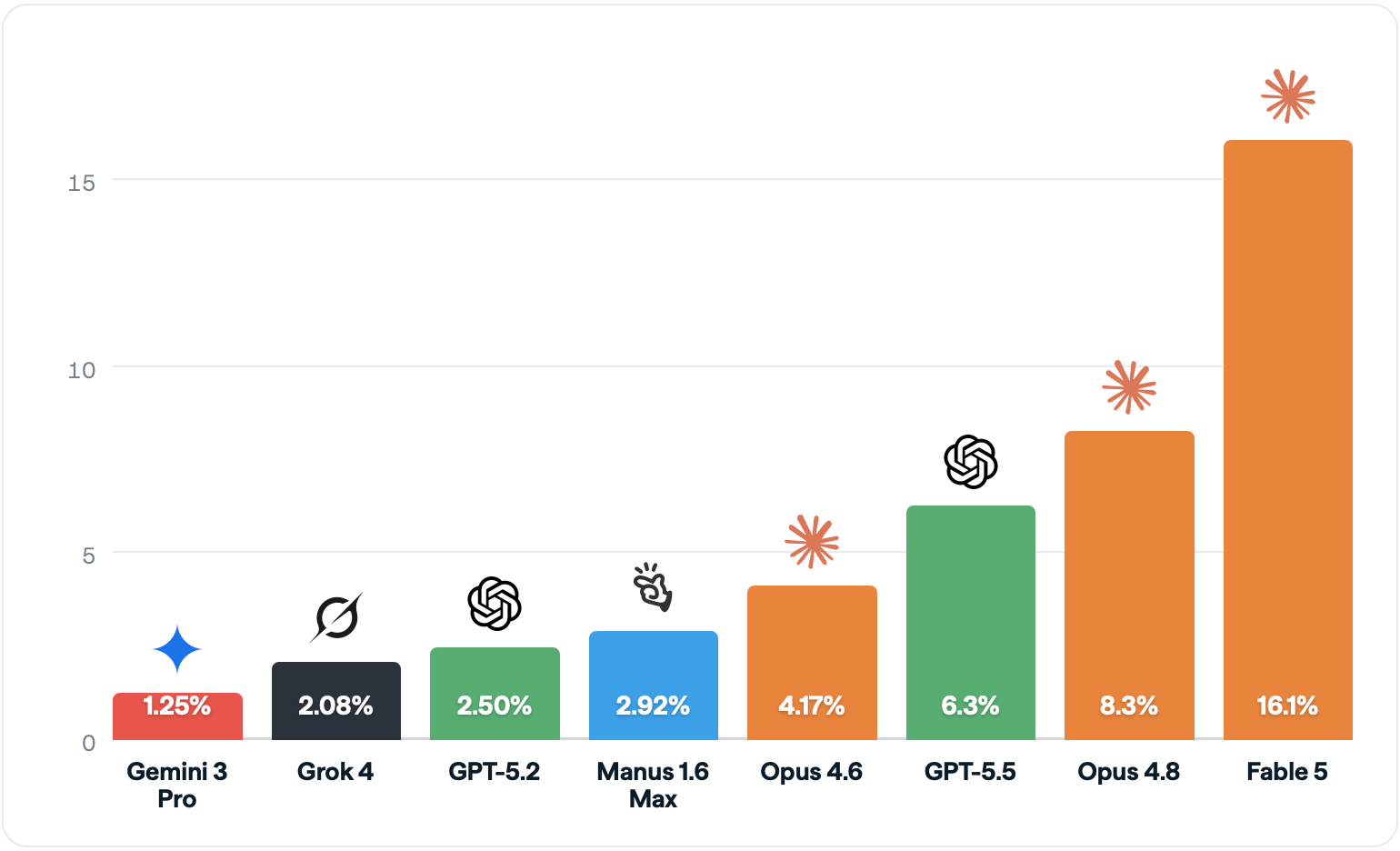
AI performance in economically valuable activities is accelerating. Although Fable 5 still falls short of professional standards in most RLI projects, its success rate of 16.1% is a huge leap compared with previous models. When RLI was published in October 2025, the highest-scoring model achieved just 2.5%. Fable 5’s score suggests that the capabilities of leading models have more than quadrupled in eight months.

New research from ByteDance also finds progress has been accelerating. On July 2, ByteDance introduced EdgeBench, a new benchmark for evaluating how well AI agents learn and improve at tasks after they have been deployed. The benchmark aims to isolate this capability by selecting tasks where older and newer models show similar performance on their first attempt, and then measuring how quickly each model improves. According to the study, more recent AI agents learn much more quickly than their predecessors, with learning speed doubling every three months.
Exponential progress could have implications for society’s ability to adapt. The exponential trends in both RLI and EdgeBench scores suggest that AI capabilities have been advancing rapidly in recent months. If leading models’ capabilities continue to accelerate along the RLI and EdgeBench trends, this could have major implications both for the knowledge work economy, where significant layoffs are already being attributed to AI, and for society’s ability to manage the novel risks that AI presents.
In Other News
Government
OpenAI is reportedly considering giving the US government a 5% stake in the company, as part of a proposal in which other AI developers would also hand over similar stakes.
Alex Bores, author of the RAISE act, lost the NY-12 democratic primary to Micah Lasher, after becoming the focus of major spending by super PACs with opposing views on AI regulation.
The Pentagon has reportedly revised its principles for military targeting, potentially enabling AI to make critical decisions in future.
The EU joined Pax Silica, a US-led initiative to secure AI supply chains.
In AI Frontiers, Afek Shamir analyzes the implications for Europe of the US government’s recent restrictions on Fable 5 and Mythos 5.
Cybersecurity agencies of the “Five Eyes” intelligence sharing group issued a joint warning on the cyber risks of AI, saying: “The timeline is not years, it is months.”
US Commerce Secretary Howard Lutnick reportedly told ASML he is concerned that China has one of the company’s EUV machines for manufacturing advanced AI chips.
In AI Frontiers, Bill Drexel argues that the US needs a stronger vision for ensuring AI perpetuates democratic values.
Industry
OpenAI is reportedly considering delaying its IPO to 2027, aiming for a valuation above $1 trillion.
360, a Chinese cybersecurity company, announced it had developed an AI tool with cyber capabilities equivalent to Anthropic’s Mythos.
Anthropic accused Chinese company Alibaba of attempting to “illicitly” extract Claude’s capabilities through almost 29 million exchanges with the model.
OpenAI, in collaboration with Broadcom and Celestica, announced a new chip, called Jalapeño, which is optimized for LLM inference and which OpenAI’s models played a role in developing.
Shares in Alphabet, the parent company of Google DeepMind, fell after high-profile researchers announced they were leaving for OpenAI and Anthropic.
Civil Society
A consortium called RAISE US, which aims to prepare the American workforce for AI job disruption, launched on June 25.
Pew Research Center published the results of its 2026 study on Americans and AI, finding that 63% of respondents think AI is “advancing too quickly.”
A complainant has, possibly for the first time in England, won a court case using an AI lawyer to perform the legal work before the trial.
The UK government published AI Scenarios 2030, exploring how the next few years could unfold, depending on whether AI progress slows, continues at a similar pace, or accelerates.
Researchers found that AI models can now outperform expert debaters at persuasion.
In AI Frontiers, Govind Pimpale analyzes how a significant AI capabilities gap between countries could undermine nuclear deterrence.
If you’re reading this, you might also be interested in other work by the Center for AI Safety. You can find more via the CAIS newsroom, the X account for CAIS, our new paper on AI deterrence, our AI safety textbook and course, our AI safety dashboard, and AI Frontiers, a platform for expert commentary and analysis on the trajectory of AI.