


Welcome to the AI Safety Newsletter by the Center for AI Safety. We discuss developments in AI and AI safety. No technical background required.
In this edition, we look at Anthropic’s IPO and a public statement on the severe risks associated with the company’s AI development. We also look at new lawsuits against AI companies, and Jensen Huang’s reinstatement as Nvidia CEO following his resignation over reports of an affair with a suspected Chinese spy.
Listen to the AI Safety Newsletter for free on Spotify or Apple Podcasts.
Anthropic Launches IPO Despite Warning of Existential AI Threats
On November 19, Anthropic launched its initial public offering (IPO), becoming the first solely AI-focused company to do so. It set a record as the largest-ever IPO, raising more than $81 billion at an initial valuation of $1.5 trillion.
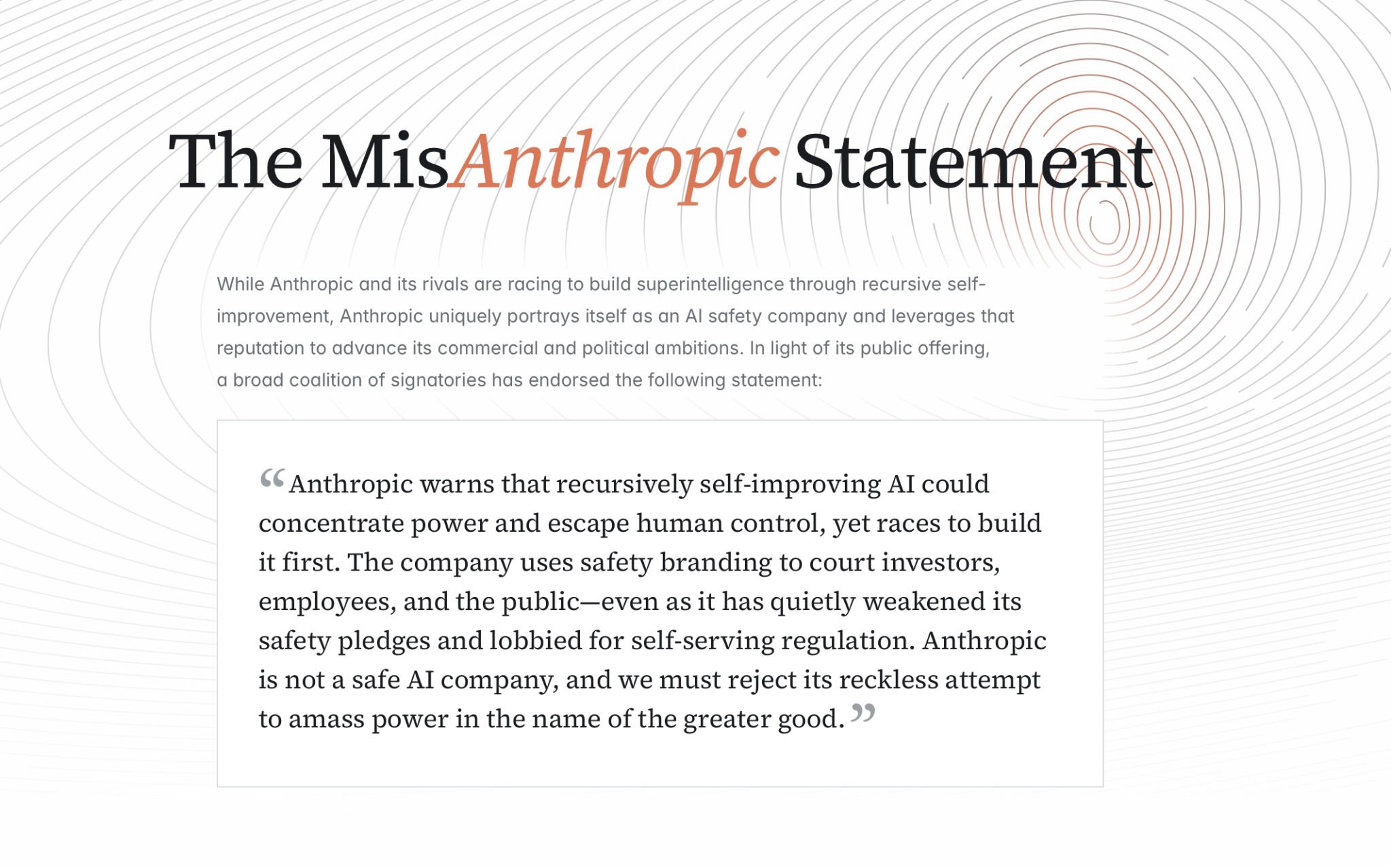
The day before the IPO, a public statement highlighted Anthropic’s risk-taking. The MisAnthropic Statement was led by CAIS and now has more than 1,000 signatories, including Nobel laureates, Turing Award winners, and Fields Medal recipients. It points out that Anthropic, more than any other AI developer, has carefully cultivated its image as a responsible actor. However, Anthropic is also racing toward superintelligence, has watered down its safety commitments, and has “lobbied [lawmakers] for self-serving regulation,” according to the statement.
Anthropic has accelerated recursive self-improvement, a major risk to humanity. Today, AI companies including Anthropic increasingly use AI for specific tasks within the AI development process. They are aiming to remove humans from the loop altogether, allowing AI models to build the next generation of AI models fully autonomously—a process called recursive self-improvement (RSI). This could trigger runaway progress too quick for humans to follow, potentially producing an AI that vastly exceeds human intelligence with no assurances that it would act in our best interests.
Anthropic has warned that full RSI “might increase the risks of humans losing control over AI systems.” Yet by focusing on improving AI coding capabilities, Anthropic has advanced RSI more aggressively than any other company. It also appears to have used its own progress toward RSI to attract investors, claiming that its accelerated development is “strengthening our leadership position.”
Anthropic still has a “halo effect,” even inside safety. Despite racing toward superintelligence, Anthropic has so far received relatively little criticism from AI safety organizations. This may be due to the deep ties between Anthropic and the AI safety ecosystem and the dominant assumption that Anthropic is the most responsible AI developer. Now, even among those protesting against Anthropic’s pursuit of RSI, there is a reluctance to view it straightforwardly as a negative force.
Anthropic has accrued significant power within AI safety. The support between Anthropic and the AI safety ecosystem goes both ways, as Anthropic’s leadership built most of the AI safety ecosystem and is roughly its sole funder. This discourages AI safety organizations and researchers from criticizing Anthropic, for fear of losing future funding or career opportunities. Anthropic’s co-founders have pledged to donate 80% of their equity, meaning that the IPO will significantly increase the company’s philanthropic giving—and potentially further strengthen its influence over the AI safety ecosystem.
AI Companies Sued Over Loss-of-Control Risks
On November 12, four public advocacy groups filed a lawsuit against Anthropic, Google, Meta, OpenAI, and SpaceX. The plaintiffs—Irreplaceable, Public Citizen, Heat Initiative, and the Alliance for Secure AI—say the companies’ behavior is “blatantly illegal” and the lawsuit seeks to prevent “their unlawful path to disaster.”
The plaintiffs say companies do not understand AI systems or how to control them. Leading figures from all five companies are quoted acknowledging the severe threats posed by advanced AI development—and RSI and superintelligence in particular. Yet all five companies are racing to build superintelligence first. The lawsuit states that AI systems are “black boxes” that companies do not fully understand. It cites the Hugging Face attack by rogue agents as an example of AIs’ unintended behavior and argues that AI companies “have no realistic plan to prevent the continued harm caused by their technology.”
The lawsuit points out that other hazardous technologies are carefully regulated. The plaintiffs quote David Robinson, who previously led OpenAI’s safety reports but resigned from the company last month. Robinson has said that “[W]e’re talking about a harm that’s much larger, for example, than a single nuclear power station melting down. And the internal controls and safety and redundancies are just nowhere near what the world expects for a nuclear power facility.”
The state of California also recently sued OpenAI over rogue-agent incidents. Last week, California Attorney General Rob Bonta filed a lawsuit against OpenAI, saying that “the Hugging Face attack was the predictable result of an internal culture at OpenAI that prioritizes growth and rapid model development over safety and accountability.”
Previous legal action against AI companies has mostly focused on their use of pirated work to train AI models, data centers’ environmental impacts, and AI models’ alleged role in encouraging users to harm themselves and others. The new lawsuits are among the first to challenge broader loss-of-control risks.
Jensen Huang’s Affair Raises Questions About Nvidia Chip Exports
On November 12, Jensen Huang resigned as CEO of AI chip company Nvidia, amid news reports about alleged affairs, including one with a suspected Chinese spy. The news raised concerns that Huang’s personal life may have influenced Nvidia’s sales to foreign companies. On November 23, Huang was reinstated as CEO by the company’s board, which said it was “confident that Mr. Huang’s reinstatement poses no national security risk.”
Nvidia’s AI chips are crucial to AI development and national security. Nvidia, an American company, creates the most advanced AI chips in the world, giving the US a major technological advantage. Since 2022, the US government has used export controls to limit sales of advanced chips to China and help prevent Chinese AI companies from catching up to their US counterparts. However, China has been trying to circumvent the restrictions, both by smuggling in chips and trying to rent access to chips located in third countries.
Huang had an affair with an executive at a company that may have sent chips to China. The FBI is investigating Alice Huang, a Chinese businesswoman and former director of a cloud-computing provider called Megaspeed. The Wall Street Journal has reported that she used her relationship with Jensen Huang to help Megaspeed become an Nvidia Cloud Partner, giving it better access to Nvidia chips. Megaspeed is based in Singapore, but according to the Wall Street Journal the company may have passed on supplies of Nvidia chips worth almost $12 billion to China. Megaspeed is also suspected of renting chips remotely to Chinese companies.
Huang’s personal life has raised questions about his pro-export lobbying. Nvidia applied for permission to sell 40,000 chips to Megaspeed in April this year. More generally, Huang has often used his closeness to President Trump to advocate for weaker export controls. While Nvidia has clear financial incentives to sell its chips abroad, the reports about Huang’s affair have drawn greater scrutiny to his lobbying efforts.
The US has introduced new restrictions on Chinese companies’ chip access. In the wake of the revelations, Treasury Secretary Scott Bessent has demanded that Nvidia explain whether it knowingly allowed its chips to reach China via third parties. The US government has also announced a new rule intended to prevent Chinese companies from remotely accessing export-controlled chips located in third countries. Nvidia has established a new committee to oversee national security policies and export controls compliance.
Market dynamics and the White House may have swayed the board. In recent years, Huang has become the face of the AI transformation, developing a public image as a rockstar CEO. Nvidia’s shares fell sharply on the news of his affairs and resignation, and there were calls for him to be brought back, including from Trump. The company’s board said reinstating Huang was “in the best interests of our stockholders, employees, partners and customers” and also said it had “received input from senior levels of the United States government.” In an interview on the day Huang was reinstated, Trump claimed to have “made the deal.” Nvidia shares soared after the board’s announcement.
In Other News
Government
President Trump announced that he and Chinese President Xi Jinping had agreed to “do some joint guardrails” on AI, following their meeting in Shenzhen. He also said he would put “tremendous penalties” on companies that build data centers outside the US.
California Governor Gavin Newsom published recommendations to strengthen the state’s AI regulations, including requiring companies to develop emergency shutdown measures for AI models and giving the state the power to cap the share of compute that developers can use for automated R&D.
Politico reported that more than two dozen members of the House of Representatives have formed a bipartisan group called the AI Safety and Innovation Caucus aiming to enable “effective, responsible legislation.”
Senator Maggie Hassan, who will become chair of the Homeland Security Committee in January, is planning hearings on AI risks after the Government Accountability Office reported it could get commercially available AI models to plan terrorist attacks.
The US government is considering requiring US companies to disclose on their websites if they use Chinese AI models.
The US and nine of its allies signed the San Francisco Declaration to cooperate on securing America’s technological lead in the AI race with China.
The EU revealed it had been targeted in an AI-assisted cyberattack, resulting in several digital systems being taken offline.
Industry
Jakub Pachocki, Chief Scientist at OpenAI, proposed using a test of AI models’ capabilities called perplexity to establish a “shared benchmark for general intelligence” and “common limits” that AI developers do not cross until they reach a concrete milestone in understanding model behavior.
OpenAI announced agreements on embedded assessments, giving experts from four independent organizations “deep access” to assess AI models’ safety.
OpenAI published a report on how it is using its own AI models to improve the design of AI chips.
Google DeepMind released its new model Gemini 4 Neon, which ranks third on an overall intelligence benchmark by Artificial Analysis, behind Anthropic’s Claude Fable 5.2 and OpenAI’s GPT-6 Astra. Gemini 4 Neon’s cost per task is about a quarter of Fable 5.2’s.
In AI Frontiers, Connor Williams proposes a new humanist movement in AI safety, arguing that the Effective Altruism movement that seeded much of today’s AI safety ecosystem is too intertwined with the AI industry and has failed in its AI safety approach.
Civil Society
Recent weeks have seen a series of technological outages affecting Microsoft, Apple, United Airlines, several US banks, and the NSA and FAA. The affected organizations said that cyberattacks were not the cause. Some of the organizations have said that the outages were due to a rush to fix AI-discovered software vulnerabilities before malicious actors could exploit them.
A movement called Stop the AI Race held marches in 12 cities on November 14, calling on the US and China to make a deal to stop the development of more advanced AI.
Levent Alpöge, a mathematician working at Anthropic, claimed to have used Claude to prove the Riemann Hypothesis, which has been one of the most famous unsolved problems in mathematics since it was posed in 1859.
The Google Threat Intelligence Group released a report saying it had detected threat actors using AI to fully automate cyberattacks for the first time, and warning that “the adversarial AI landscape has reached a critical inflection point.”
Research from the children’s safety organization Childlight found that reports of AI-related child sexual abuse material had increased by more than 8,400% in two years.
OpenAI’s Head of Strategic Futures, Dean Ball, published an essay about a “silent consensus” among those working in AI that the technology will inevitably lead to “the termination of human primacy in the world.”
The Machine Intelligence Research Institute (MIRI) launched a campaign, urging people to tell AI companies we do not accept the risks they are imposing on society.
Vals AI, an AI model evaluator, found that several frontier AI models would comply with instructions to conduct autonomous drone strikes, with their targets including civilians, ambulances, and surrendering soldiers.
In AI Frontiers, Sumnima Singh analyzes biological risks, arguing that AI-assisted experts may pose a much greater threat than AI-assisted novices—but are much less well studied.
If you’re reading this, you might also be interested in other work by the Center for AI Safety. You can find more via the CAIS newsroom, the X account for CAIS, our Introduction to AI Safety course on Coursera, our paper on ethics for a human-AI future, our AI safety textbook and course, our AI safety dashboard, and AI Frontiers, a platform for expert commentary and analysis on the trajectory of AI.